The Black Rhino
(Diceros Bicornis)
Names:
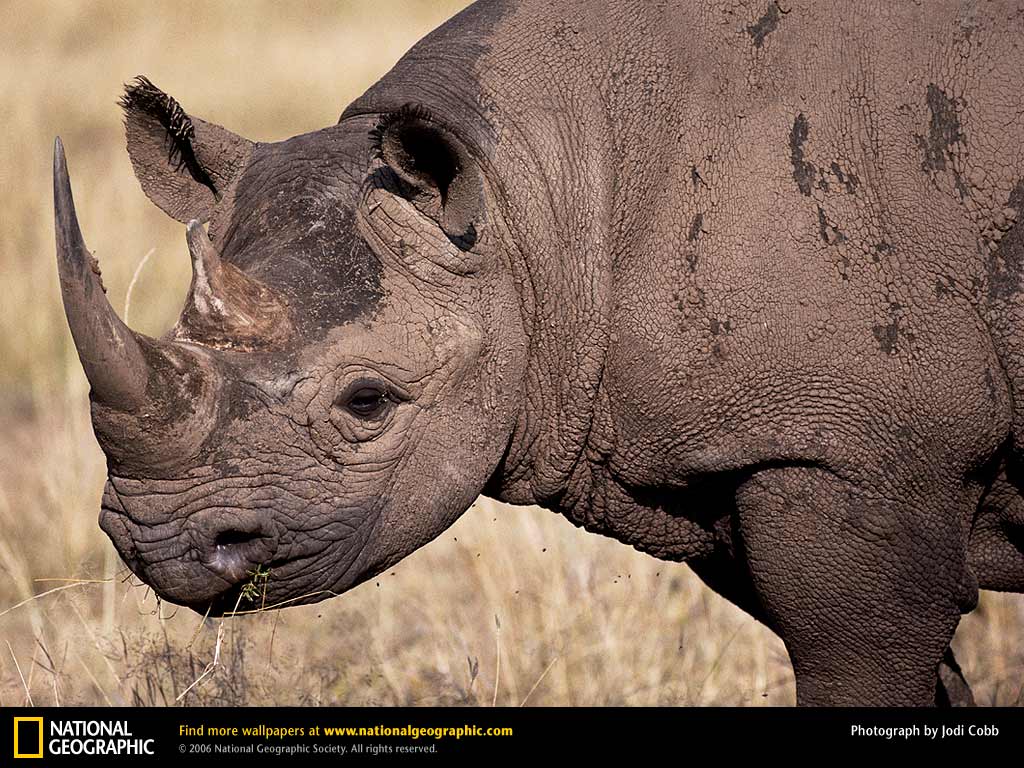
Black rhinos aren’t actually black—its name was probably chosen to distinguish it from the other species of rhinos that inhabits the same continent (the White Rhino which is also a misnomer). “Black” may also have come from the dark-colored local soil that usually covers up its skin after it wallows in the mud.
It is also called the prehensile or hook-lipped rhinoceros. The upper lip of the black rhino which is adapted to feed of from trees and shrubs is its best distinctive characteristic.
Its scientific name, Diceros Bicornis comes from the Greek “di” (two) and ceros (horn); “Bicornis” from the Latin “bi” (two) and “cornis” (horn).
Physical Features:
Size—
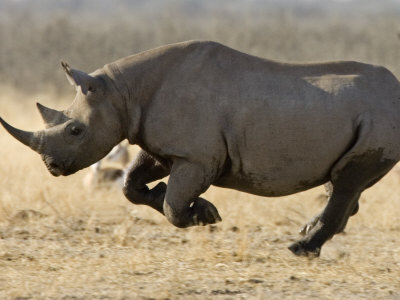
Weight: 1,750 - 3,000 lbs
(800 - 1,350 kg)
Height: 4.5 - 5.5 ft (1.4 - 1.7 m)
Tall at shoulder
Length: 10- 12.5 ft (3.0-3.8m) length of head and body
Horn—
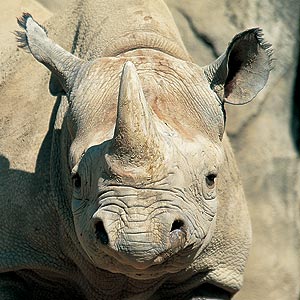
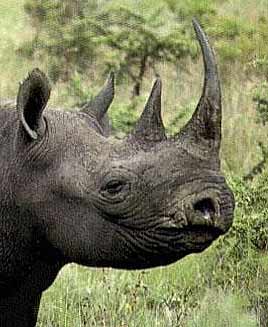
Black rhinos have two horns. The front (anterior) horn is larger and measures 1 foot, 8 inches (0.5 - 1.3 m). The rear (posterior) horn is smaller and measures up to 22 inches (55 cm) long.
Other—
-broad snout with a prehensile lip adapted for grasping branches and leaves
During the last century, the black rhino has suffered the most dramatic decline in population of all the species. Between 1970 and 1992, the population of this species decreased by 96%. In 1970, it was estimated that there were approximately 65,000 black rhinos in Africa – but, by 1993, there were only 2,300 surviving in the wild. Intensive anti-poaching efforts have had encouraging results since 1996. Numbers have been recovering but still are increasing very slowly. With the growing purchasing power of many Asian countries, and the existence of organized gangs of poachers who sell rhino horn to black market syndicates in some range countries, the poaching threat remains great and anti-poaching efforts must be continued and accelerated.
- Lives in Africa, primarily in grasslands, savannahs and tropical bush lands
- Four black rhino sub-species—the eastern, southwestern, southern central and western: the western subspecies is thought to be extinct
- Browsers--prehensile upper lip is adapted for grasping and holding leaves and branches of shrubs and trees
- Black rhinos can live to be 30-35 years in the wild and more than 45 years in captivity
- Gestation lasts approximately 15-16 months—mothers can give birth to one calf every 2.5-3 years
- Females reach sexual maturity between 4 and 7 years of age
- Males mature between 7 and 10 years of age.
Black rhinos are semi-social and territorial. Females and “adolescents” generally are social, but bulls are typically solitary. Sometimes, satellite males may reside within one another’s territories. Adult female black rhinos have overlapping ranges and are not really as solitary as often portrayed. Males are generally solitary and may be territorial. Black rhino home ranges vary greatly depending on the habitat and to some extent on sex and age.