History
Rhinos have existed on Earth for more than 50, even 60 million years; at one time constituting a diverse array of species that lived throughout North America and Europe as well as Africa and Asia.

However, only 5 species of rhinos precariously remain today. Since their origin (which may go all the way back to when dinosaurs roamed the earth) they have been an extremely diverse group. They had represented many different “ecotypes”—some were like giraffes, others horses, hippos and of course the modern rhino. Rhinos’ habitats in the past extended into temperate and even arctic regions.
Extinct rhinos include:
--Paraceratherium: the largest land mammal ever, resembling a large, muscular giraffe
--Telecoeras: a uni-horned hippo-like grazer commonly found in North America
--Wooly Rhino (Coelodonta Antiquitatis)
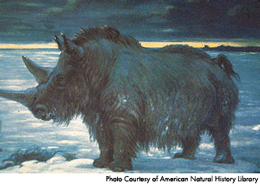
The Woolly Rhino, Coelodonta (Greek meaning “hallow teeth”) Antiquitatis (Latin meaning “old”) first appeared around 350,000 years ago and may still have been alive until as late as 10,000 years ago. Their fossils are commonly found and discovered throughout Europe and Asia—however, they have not yet been “seen” in North America or Ireland. Well-preserved remains have also been discovered frozen in the ice or buried in oil-saturated soil. In Staruni (Ukraine), the whole carcass of a female Woolly Rhino was discovered buried in the mud—the combination of oil and salt preventing the remains from decomposing and allowing soft tissues to remain intact.
They are “common” throughout Northern Europe and Eastern Asia, especially in Russia. Their range had extended out from South Korea all the way to Scotland and to Spain. During the later years of the Pleistocene Period, the Woolly Rhino may have had the largest range of habitation known to any rhino whether living extinct. In fact, the Woolly Rhinos frequently inhabited the same places as the Woolly Mammoths…however, they have never seemed to manage to move across the Bering Strait and extend the range into North America.
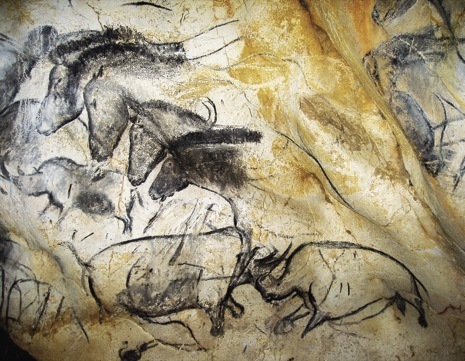
The Woolly Rhino’s entire body was covered in a thick, shaggy coat which consisted of two types of hair: a thin, dense undercoat and a long rigid covering hair; there have even been cave paintings to suggest that there had been a darker band of fur around their middle. It was a herbivore which grazed specifically upon grass, shrubby sprouts, forbs, lichens and mosses. The Woolly Rhino had a broad front lip.
There have been fossils showing abrasion marks that may have been caused by the motion of the head as it pushed snow away when searching for grass. These rhinos also lived alone or in small family groups. They have been hunted by humans and are featured on the walls of caves in France 30,000 years ago.
The Sumatran Rhino is the last representative of the Woolly Rhino family.
Physical Characteristics
Size
Weight: 42 to 3 tons
Height: 6 ft (2m) tall at shoulder
Length: 10- 12.5 ft (3.0-3.8m) length of head and body
Horn
There are two horns. The front, larger (anterior) measured up to 3 ft (1m) and has a flattened shape from side to side, like a wooden plank.
Rhinos may even be the source of the myth concerning unicorns—their horn was said to be a panacea (a solution or remedy for all difficulties/diseases) for all sorts of ailments. The Venetian explorer Marco Polo described Sumatran rhinos as unicorns in 1298, saying:
“There are wild elephants in the country, and numerous unicorns, which are very nearly as big. They have hair like that of a buffalo, feet like those of an elephant, and a horn in the middle of the forehead, which is black and very thick.”
