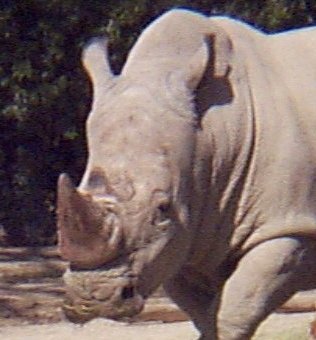
The White Rhino
(Ceratotherum Simum)
Names:
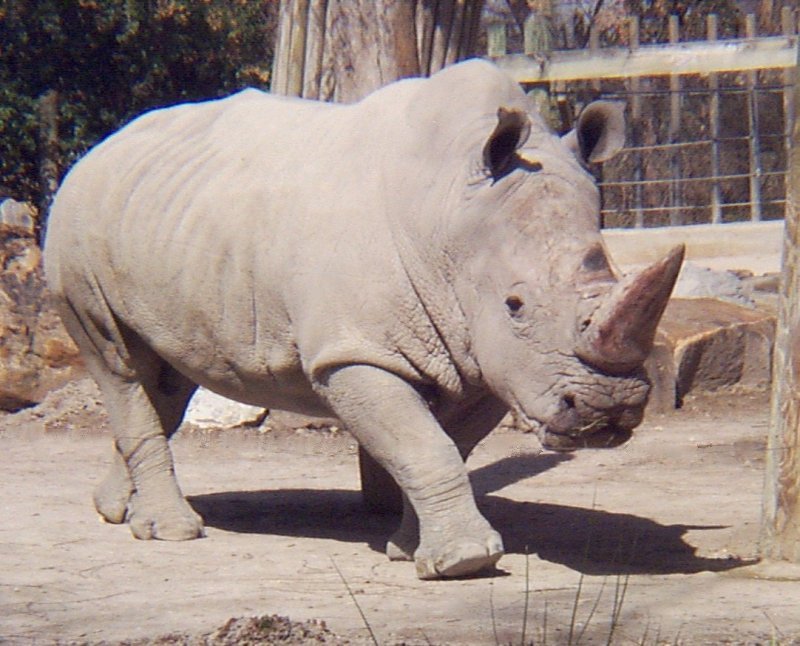
The “white” in White Rhino comes from a misunderstanding. The Afrikaans word describing its mouth: “weit”—wide was misinterpreted as the word “white”. They are sometimes called the square-lipped rhinoceros because its upper lip does not have the same prehensile (animal limb/tail capable of grabbing/grasping) “hook” which the other rhino species do have.
The scientific name Ceratotherium Simum comes from the Greek “cerato”, meaning horn; “thorium” meaning wild beast”; simum from the Greek simus meaning “flat nosed”.
Physical Features:
Size—
Weight: 4,000-6,000 lbs
(1,800 - 2,700 kg)
Height: 5 – 6 feet (1.5 – 1.8 m)
Tall at shoulder
Length: 12.5-15 feet (3.8 - 5m) length of head and body
Horn—
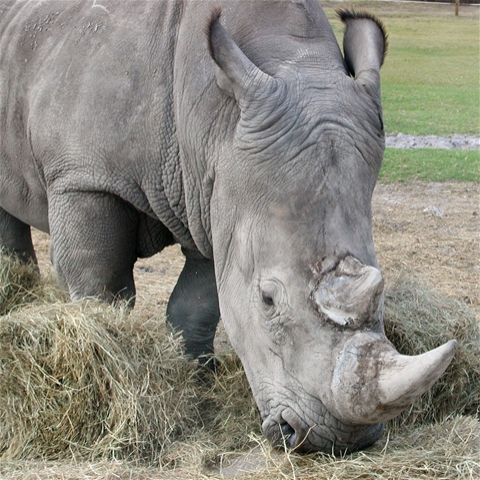
White rhinos have two horns. The front (anterior) horn is larger and measures 37 - 40 inches (94 - 102 cm), (northern subspecies), 37 - 79 inches (94 - 201 cm) (southern subspecies). The rear (posterior) horn is smaller and measures up to 22 inches (55 cm) long.
Other—
-broad snout with a square lip
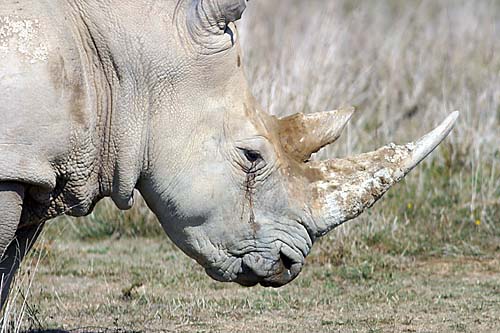
The white rhino is one of the largest species of land mammal after the elephant. The white rhino is also the least endangered og the living rhino species…however, of its two distinct subspecies, only the population of the Southern White Rhino population is believed to remain alive: the Northern White Rhino is believed to be extinct due to poaching.
· Lives in Africa—long and short-grass savannahs
· Grazers—wide, square upper lip adapted to feeding upon grasses
· Can live to be 50 years of age
· Gestation lasting up approximately 16 months—mothers give birth to one calf every 2-3 years
· Females reach sexual maturity between 6 and 7 years of age
· Males mature between 7 and 10 years of age.
White rhinos are semi-social and territorial. Females and “adolescents” generally are social, but the bulls are usually solitary. Sometimes, satellite males may reside within one another’s territories.